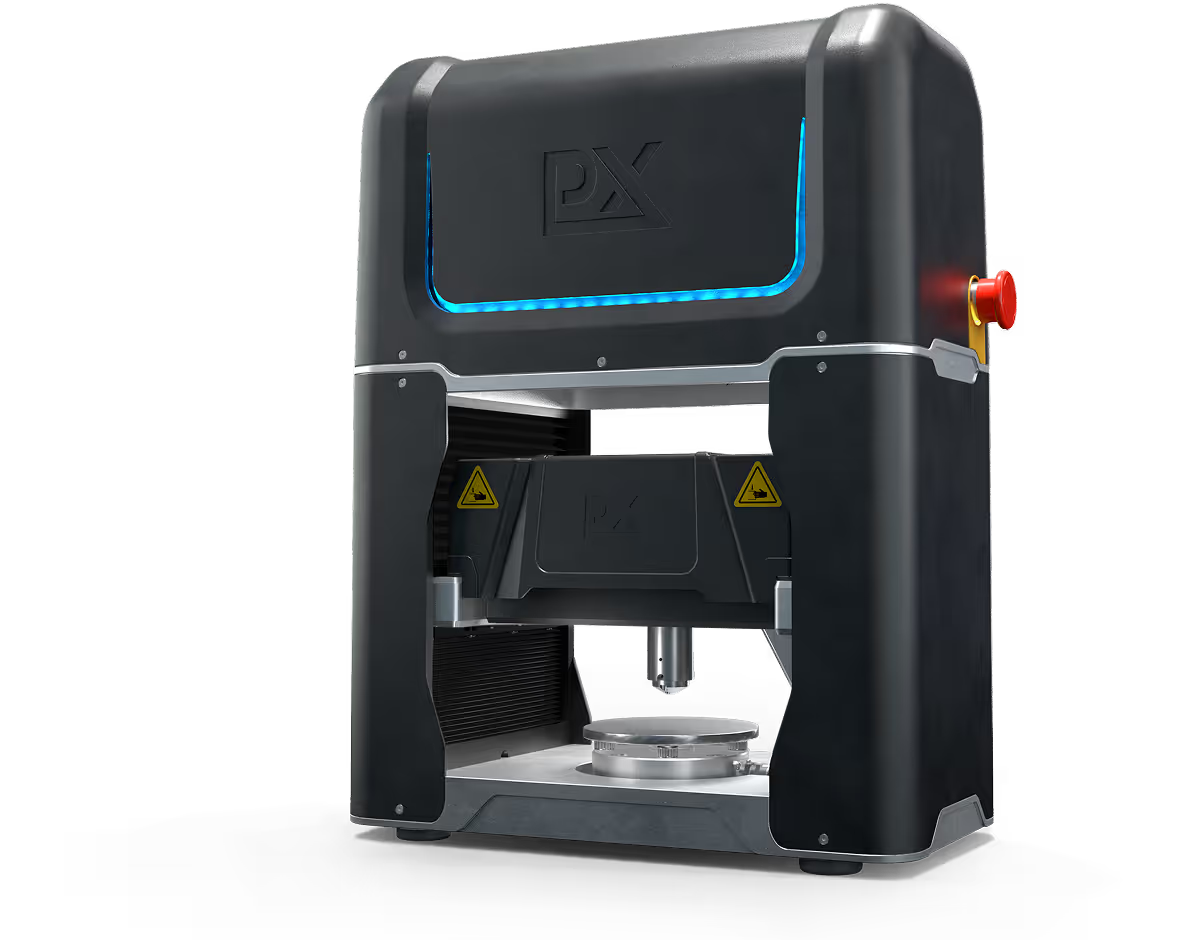
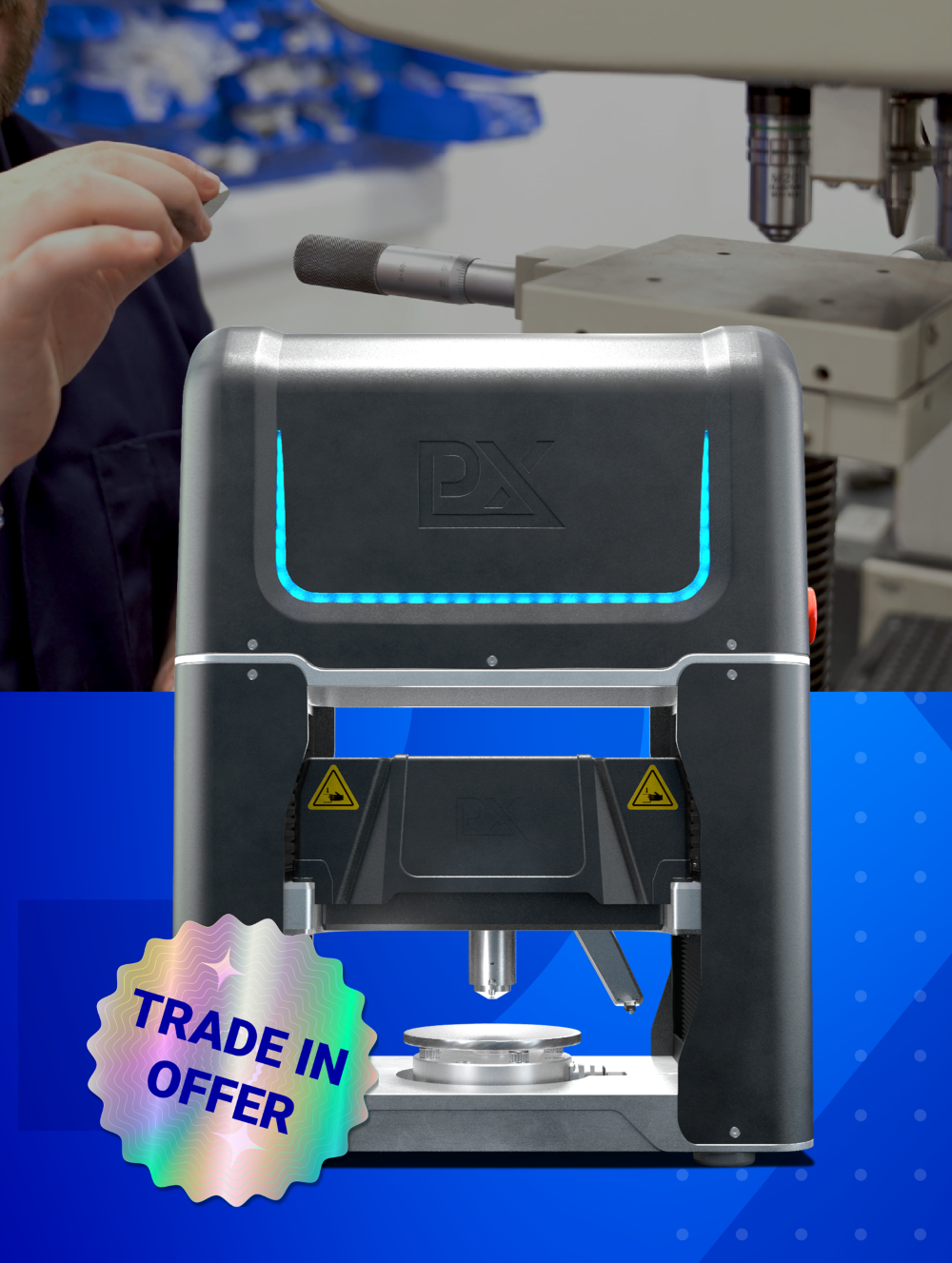
PLX-Benchtop
Testing Machine
Materials engineers turn to the PLX-Benchtop mechanical testing machine when they need true mechanical properties, not hardness proxies, and when destructive tests are too slow, impractical, or even impossible.

.avif)

Powering testing at NASA, Airbus, and more


.png)








Reduce reliance on tensile testing withfast & cost-effective insights
The PLX-Benchtop provides tensile testing results in a fraction of the time and with a fraction of the material. By adding the PLX-Benchtop to their in-house testing workflow, a leading additive manufacturing OEM reduced tensile test requirements, saving over $125k annually on testing and material costs alone.

Non-destructive
Measure stress-strain curves and metal strength parameters like yield and ultimate tensile strength (UTS) non-destructively.

Results in minutes
Generate stress-strain results in as little as 5 minutes with minimal sample prep and streamlined testing - a fraction of what’s required by traditional tensile tests.

99% less material
Test directly on real components and samples, as small as 1.5 x 1.5 x 0.75 mm (0.06 x 0.06 x 0.03 inches), bypassing the need for costly tensile testing specimens.
More data, more informed engineering decisions
Test the untestable
Unlock stress-strain curves from welds and thin, small, or complex samples, unsuitable for tensile testing.
Map what matters
Indents can be spaced as close as 1.5 mm / 0.06 inches apart, allowing property mapping across welds and complex parts, revealing variations that tensile testing may miss.

How PLX-Benchtop testing Works
The PLX-Benchtop is powered by PIP Testing (Profilometry-based Indentation Plastometry), a method developed by Plastometrex and internationally recognised by ASTM standard E3499-25. PIP Testing is non-destructive, measuring stress-strain response via a small indentation and finite element analysis. Unlike a standard indentation hardness tester, which returns only a hardness value, the PLX-Benchtop extracts full stress-strain curves from a similar indentation. The method has been extensively validated against tensile testing, both by Plastometrex and independent third parties including Nikon (see Nikon validation study).
Indent sample
A small indent (ranging from ~0.25-1 mm wide and ~25-200 µm deep, depending on indenter size) is created on the material’s surface.
Measure shape
The indent is then scanned by an integrated profilometer, which captures the shape of the material deformation.
Finite element analysis
Using advanced finite element modelling, the software runs a simulation of the same indentation test, continuously adjusting the material properties in the simulation until the simulated indent matches the real one.
Instant results
Once matched, the user is presented with a stress-strain curve, which provides key mechanical properties including yield strength and ultimate tensile strength (UTS).

The best of both worlds
With PIP, you get all the benefits of tensile and hardness testing in one, with none of the limitations.
How do the results of PLX-Benchtop testing compare with tensile testing?
Use this interactive tool to discover the level of agreement between PIP testing with the PLX-Benchtop and tensile testing results.
Choose device, base metal, alloy, or processing method
Explore comparison data between PIP and tensile
Discuss your materials with our Application Engineers


See what our customers say

Dr Calvin Stewart



Dr Robert Deffley
Principal Engineer

Jed Robinson-Wall
Materials Scientist at Renishaw


Behrang Poorganji
VP of Materials Technology at Nikon AM Synergy


Prof. Roger Reed FREng FIMMM
Professor of Materials and Solid Mechanics at Oxford University


Tony Fry
Principal Scientist at National Physics Laboratory


Mark Jackson
Research & Innovation at Leonardo Helicopters UK


Ian Brooks
Technical Director at Additure


Benjamin Haigh
Materials Scientist at Renishaw

Kazuhiro Mizuta
Managing Director at Aeroedge

.png)
Dr Calvin Stewart
Innovation Scholar & Associate Professor at Ohio State University


Working in harmony with the Plastometrex technology suite
From the bespoke software that powers the PLX-Benchtop and provides a detailed analytics bank, to our expanding range of add-on modules that unlock new testing capabilities.
PLX-HotStage
The PLX-HotStage is an add-on module for our benchtop testing device that extracts metal stress-strain curves from indentation test data at temperatures of up-to 800 °C

CORSICA+
Explore software-driven performance improvements, expert application support, and a host of other benefits with our CORSICA+ subscription.

Discover how the PLX-Benchtop can work for you
Receive a tailored quote, or book a demo with our application engineers to see the system in action.