There's a gap in conventional mechanical testing.
Tensile testing delivers full stress-strain data, but it’s slow, costly, and even impossible when test coupons can’t be extracted. Hardness testing is faster and more flexible but provides only a proxy for true mechanical properties like yield and tensile strength.
PIP Testing was developed by Plastometrex to bridge this gap, combining the speed and versatility of hardness testing with the stress-strain data of tensile.


Where engineers go for deeper mechanical insight
PIP Testing is used by engineers who need more than proxy measurements or slow, destructive tests. It provides fast and direct access to true mechanical properties with high spatial resolution, making it a practical choice for studying material variation, validating processes, and generating tensile-equivalent data efficiently.
.avif)
“There was a clear requirement to take the benefits of a hardness test and apply numerical methods to extract real mechanical property data like yield and tensile strength.”
Dr Jimmy Campbell,
Co-founder and CTO


How PIP works
At its core, PIP converts a simple indent into a full stress-strain curve through three key steps:
Creation of an indent
Measurement of the residual indent profile
Analysis of the indent profile using accelerated inverse finite element analysis to determine the stress–strain curve
The resulting stress–strain curve includes yield strength, work-hardening behaviour, ultimate tensile strength, and uniform elongation (at the onset of necking).
Where PIP makes a difference

NASA utilises PIP to map property variations in builds and welds for high-temperature alloys.

The team at Nikon Advanced Manufacturing are using PIP to rapidly characterise LPBF build properties across multiple AM alloys.

WPI is using PIP Testing to advance large-scale additive manufacturing research.

Renishaw is validating AM process parameters and ensuring consistent mechanical performance with PIP Testing.

DEEP is using PIP to study process-parameter-property relationships in large-scale WAAM structures intended for deep-sea environments.
An international standard for PIP Testing
Following global adoption, PIP Testing is now defined under international standard ASTM E3499-25, providing a recognised framework for consistency, comparability, and wider industrial adoption.
“PIP’s ASTM accreditation provides a globally recognised solution to faster, easier and more cost-effective mechanical testing.”
Behrang Poorganji, VP of Technology


Backed by research
Profilometry-based Indentation Plastometry (PIP Testing) was developed by Plastometrex following more than a decade of research into how indentation data can be used to extract true mechanical properties from metallic materials.
The method has been used in peer-reviewed research across materials science, manufacturing, and mechanical engineering. It has been applied to study everything from additive manufacturing builds to high-temperature alloys and welded structures.
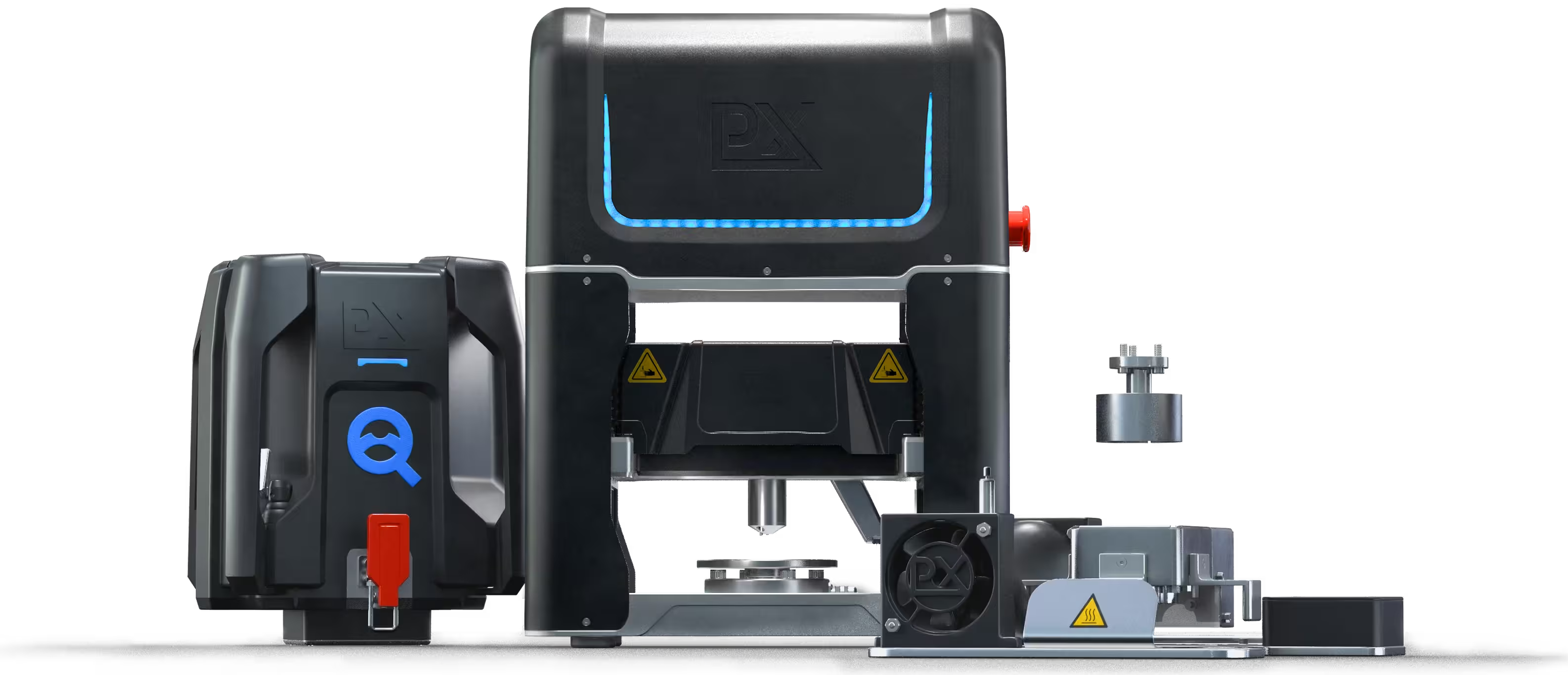
PIP Testing underpins the full suite of Plastometrex systems. This includes worktop-based testing with the PLX-Benchtop, high-temperature testing with the PLX-HotStage, and in-situ mechanical testing of assets using the PLX-Portable.