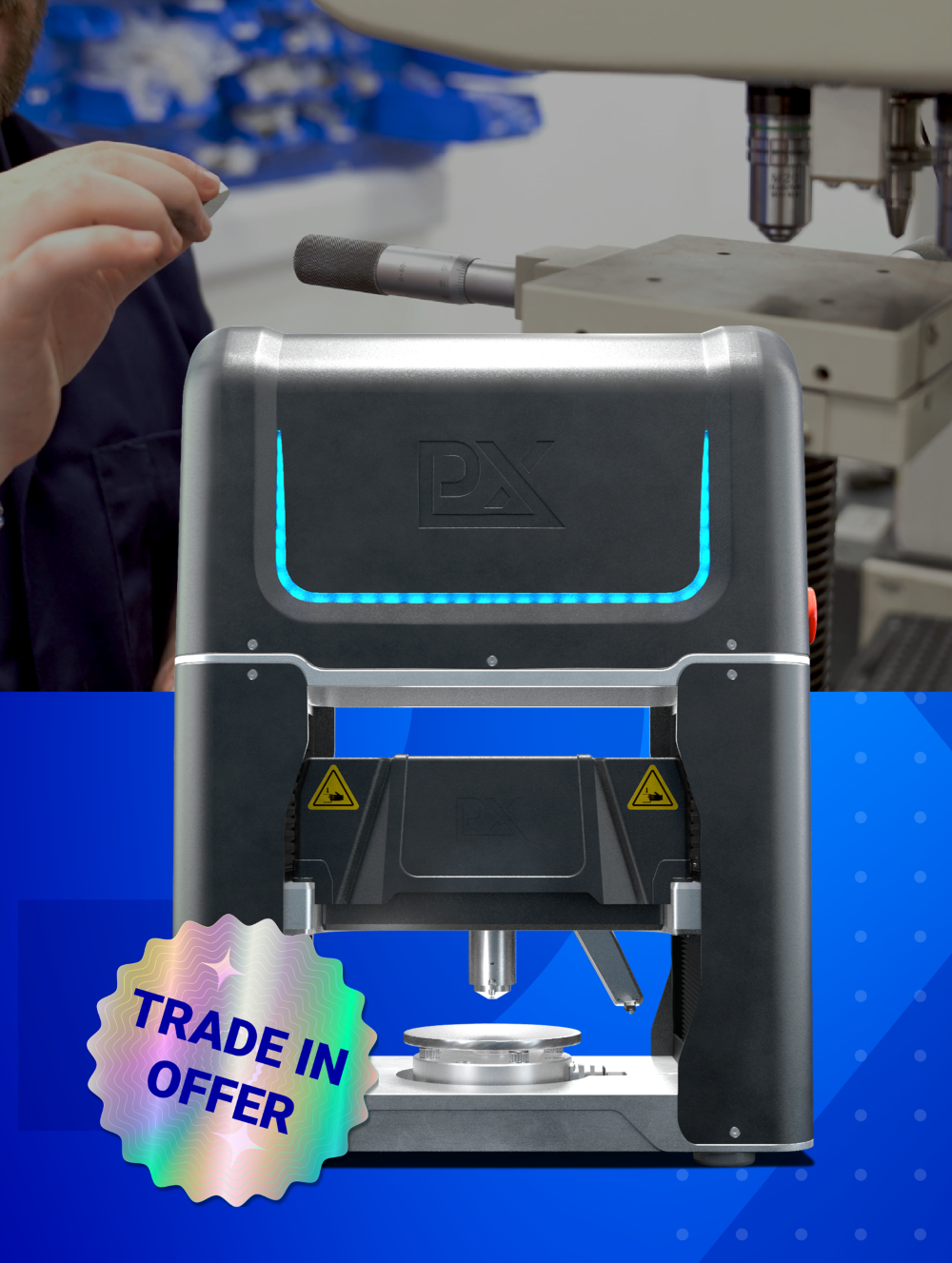
Plastometrex, the company behind commercial indentation Plastometry, has unveiled its new MultiScale capability, designed to capture high-resolution mechanical property variation across thin, welded, and complex geometries that are typically inaccessible to conventional mechanical testing.
Developed in response to a common gap in mechanical testing, the new MultiScale capability for Plastometrex’s PLX-Benchtop testing system enables engineers and materials scientists to:
• Test directly on components and specimens as thin as 0.75 mm, extracting accurate mechanical data without destructive sectioning.
• Map mechanical properties across welds and complex geometries with 1.5 mm indent spacing, providing high-resolution insight into local variations and process performance.
This innovation is powered by Plastometrex’s ASTM standardised PIP Testing (Profilometry-based Indentation Plastometry), a physics-based approach that extracts stress-strain curves from indentation test data using accelerated inverse finite element analysis. It’s this testing methodology that underpins the PLX-Benchtop: a fast and compact system that non-destructively gathers yield and ultimate tensile strength (UTS) data from an automated five-minute test. The standard indenter size in every PLX-Benchtop device is 1000 µm; however, with the addition of the MultiScale capability, users now have access to 250 µm and 500 µm indenters, allowing mechanical behaviour to be captured at a variety of scales.
Dr Jimmy Campbell, CTO at Plastometrex, had this to say:
“We developed the MultiScale capability to give engineers access to the data they’ve been missing. Many of our users work with parts that are too thin or geometrically complex for conventional mechanical testing. We wanted to change that, to make it possible to test the untestable and capture reliable property data wherever it’s needed.”
MultiScale has already been used by NASA to characterise local variations in mechanical properties within spaceflight components. By mapping stress-strain responses across an additively manufactured part, process-structure-property relationships were revealed, which helped to inform manufacturing optimisation and reduce conservative safety factors. One particular finding which stood out was how yield strength fell by approximately 15% as wall thickness decreased: an insight which would have been missed by tensile testing
Dr Mike Coto, CCO at Plastometrex, added:
“MultiScale gives users the ability to zoom in on the fine details that drive overall performance. That level of resolution supports more efficient design decisions, whether that means adjusting print parameters, refining weld procedures, or reducing unnecessary safety margins while maintaining structural integrity.”
The MultiScale capability is now available to all PLX-Benchtop users through their CORSICA+ subscription.