Tensile testing is the most trusted mechanical test we have, and one of the most limited. It reduces a whole component to a single stress-strain curve pulled from one location in one direction, which works cleanly when material is uniform. As parts grow more complex, that single number and the reality inside the part keep drifting further apart.
Tensile testing is the most reliable and traceable mechanical test we have. It's also one of the most limited.
A tensile test produces a single stress–strain curve from a single specimen. That curve is typically taken from one location, aligned in one direction, and reduced to a small set of values: yield strength, ultimate tensile strength, and elongation. These values are then used to represent the mechanical behaviour of the entire part.
When material is uniform and part geometry is simple, this approach works well. However, as components have become more complex, the gap between tensile test data and material strength reality has diverged more and more.
Tensile testing as the gold standard
Few engineering tests have the credibility or longevity of tensile testing. The geometries are standardised across industries (ASTM E8 / E8M, E21 for elevated temperature, BS EN ISO 6892), and the data is unambiguous, providing engineers with a full stress-strain response. This data is easy to interpret and implement into design frameworks.
Further, regulators recognise the method. Suppliers, customers, and certification bodies expect to see it. From a practical standpoint, tensile testing has more than a century of adoption behind it. Qualification pathways, certification processes, and material databases are built around the data it provides. Engineers trust the method because it has consistently delivered reliable information within its intended scope.
When you need a single, defensible number for a material, tensile testing is hard to beat. It was designed for a specific job, namely characterising the bulk mechanical properties of a homogeneous specimen, and for that job it remains the gold standard.

The limits of a single specimen
The presence of variation across components is not a new observation, but the challenge is to determine how much variation exists, and where. The honest answer is that many engineering teams don’t know because gathering this data is often impractical, if not impossible using tensile testing.
The constraint is geometric: a tensile bar requires a specific shape, prepared to standard, with a continuous gauge length large enough to capture deformation evenly. To get one usable data point, you need a defined volume of bulk material to machine the specimen from. To get a property map across a component, you'd need dozens of those data points, each extracted from a slightly different location, each requiring its own coupon, preparation and pull.
For most real parts, that's not feasible. The component may not be large enough to yield dozens of E8-compliant specimens, or the geometry won’t lend itself to repeatable extraction. The features engineers most want to characterise are precisely the features tensile coupons can't be cut from without destroying the part or sampling something that isn't representative of the location of interest.
Tensile testing reduces variations into a single number that may or may not reflect the local properties at failure-critical region of parts. However, engineering decisions are often shaped around the yield and ultimate tensile strength data they are able to gather from batches of tensile samples. These values feed directly into design decisions that inform component safety. When those inputs assume uniformity, the outputs inherit that assumption.
This creates a gap between what is measured and what is actually present in the part. We refer to this as the mechanical testing gap.

A complementary approach
This is the gap that Profilometry-based Indentation Plastometry (PIP testing) was developed to address. PIP testing, formalised in ASTM E3499-25, uses a spherical indenter and inverse finite element analysis to extract tensile-equivalent stress-strain curves from small, indented volumes. Unlike microhardness, which gives a single hardness number, PIP returns yield strength, UTS, and work-hardening behaviour: the same outputs a tensile test would.
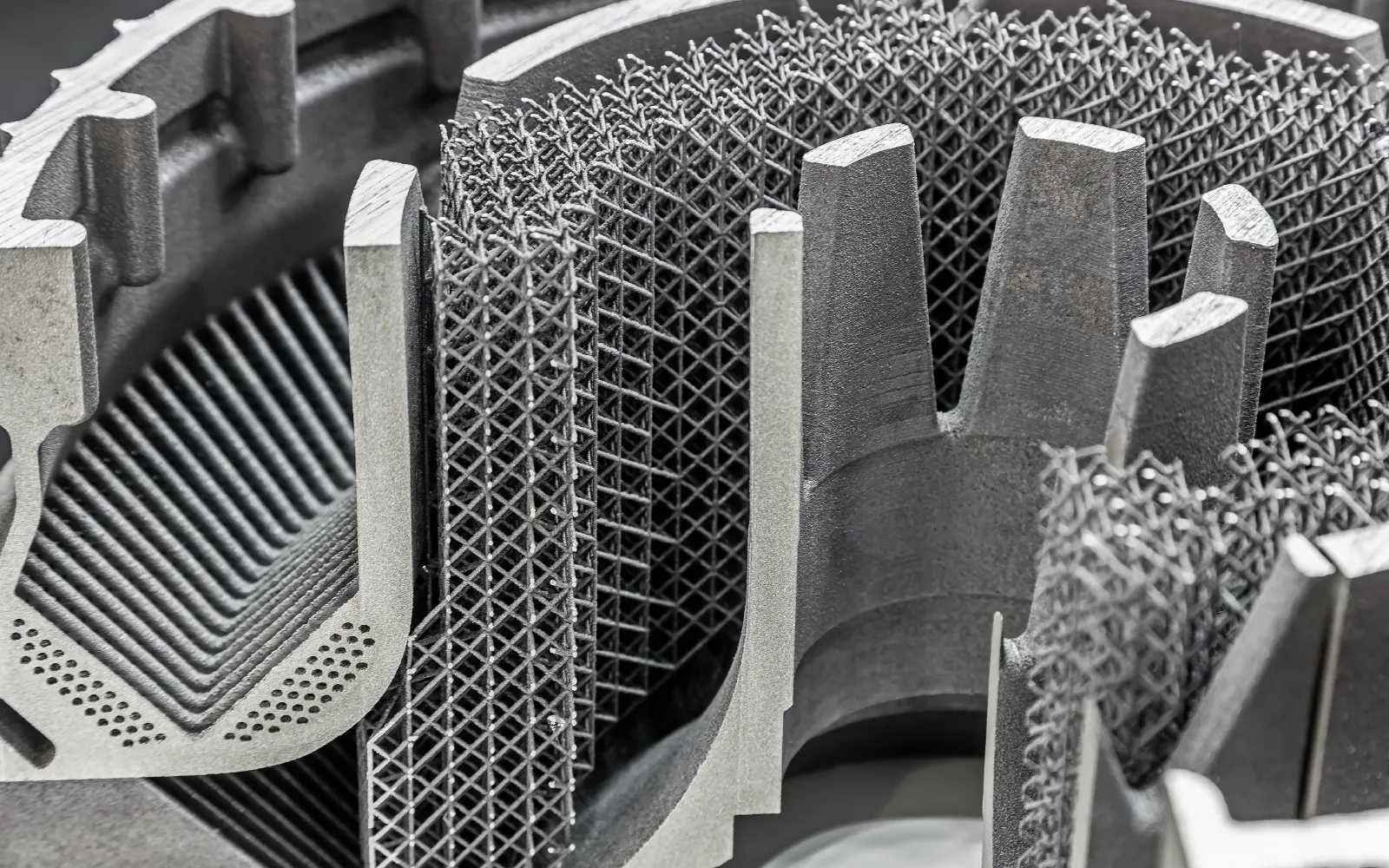
The key difference is sample size. A PIP measurement only requires a small, locally flat surface, which means properties can be measured at many points across a single component. The features that cannot be tested with tensile, such as welds, HAZs, thin sections, and AM walls, become measurable.
With spatially resolved PIP data, it becomes possible to:
- Identify regions of lower or higher strength within a part
- Relate property variation to geometry or process conditions
- Reduce uncertainty when applying safety factors
- Make more informed decisions about design and manufacturing adjustments
PIP testing is a natural complement to tensile testing, and one that's been benchmarked against the gold standard repeatedly. NASA's recent study of laser powder bed fusion HR-1, an Fe-Ni superalloy, is a useful illustration. PIP-derived yield strength agreed with NASA's tensile data to within 2.6%, and UTS to within 0.4%. The same study mapped properties across a single C-ring and found a roughly 15% drop in yield strength as wall thickness changed — the kind of local variation that standard tensile tests would have completely missed.
That's what mapping unlocks: a layer of resolution the bulk number alone can't provide, validated against the technique that's been the gold standard for a hundred years.
Bulk and local, working together
One way to understand the relationship between tensile testing and PIP is to see how an engineering team would use them in sequence on the same job.
Take additive manufacturing qualification. A team developing a new build for a structural component needs to understand how mechanical properties vary across the build. The process window has dozens of parameters, and locking in a recipe means characterising small witness coupons across all of them, often hundreds of samples in total, before the build can be signed off.
That's a job tensile testing struggles to scale to. Often, witness coupons aren't large enough to yield E8-compliant specimens, and even if they were, machining and pulling that volume of bars would take weeks, if not months. This is where PIP testing comes in.
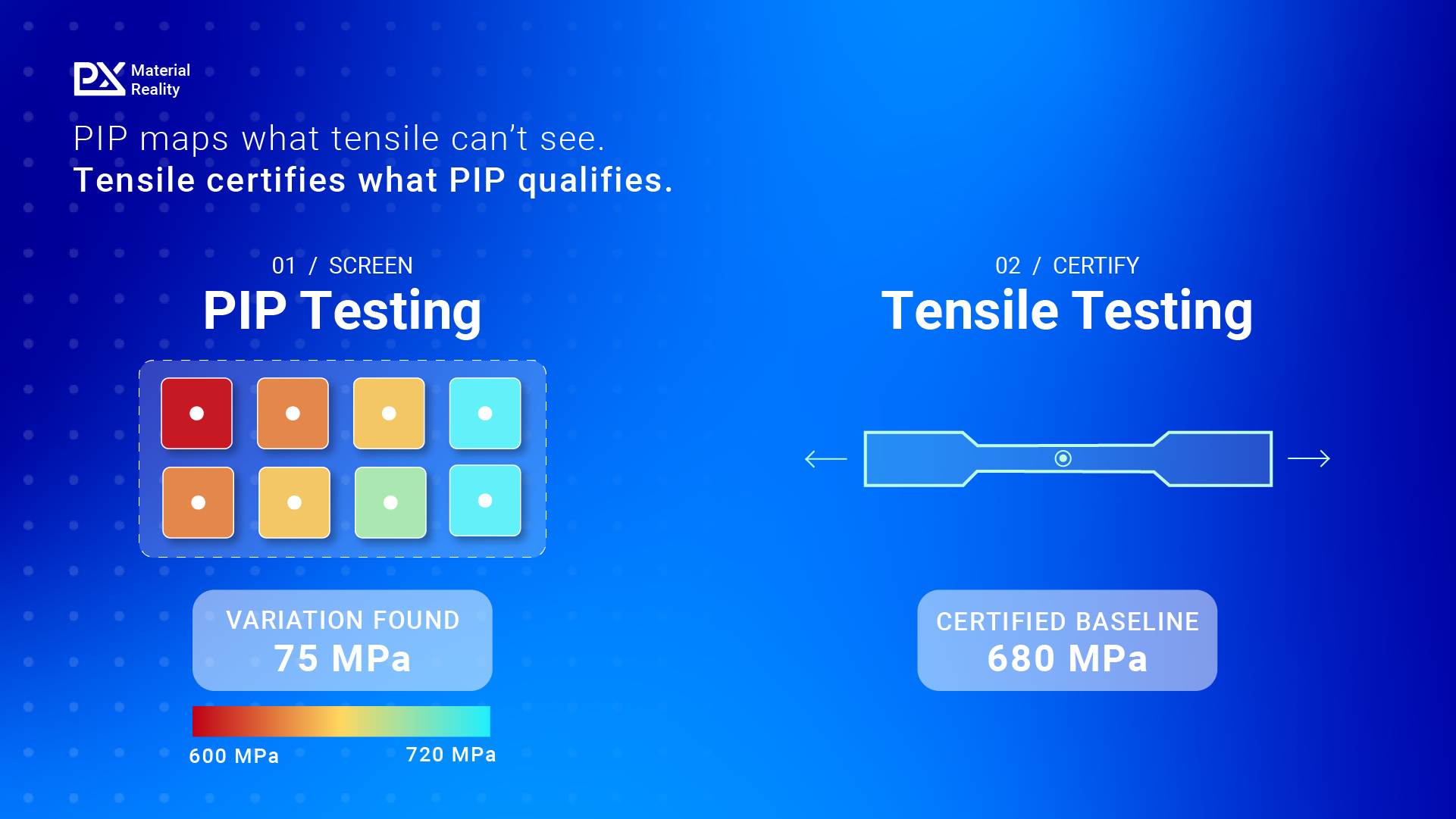
The same density cubes a team is already producing for porosity analysis can be PIP-tested to extract local stress-strain data across the build. A property map emerges from samples already sitting on the bench, enabling the engineers to understand which parameter combinations deliver the properties needed by the part. Once the parameter window is locked in, tensile testing returns to deliver the certified baseline data the qualified build will be signed off against.
In this way, PIP closes the local-variation gap that tensile can't reach, while tensile provides the bulk mechanical property data that PIP results sit alongside. Used together, they give engineering teams a level of confidence in the mechanical performance of their parts that neither technique could deliver alone.
This is what closing the mechanical testing gap looks like in practice.
The future of mechanical testing
For the last hundred years, tensile testing has remained the standard. The next ten years are likely to look different. As additive manufacturing scales up in regulated industries, welded and joined structures get more complex, and design codes start asking harder questions about local property variation, mapping will become a normal part of the engineering toolkit, sitting alongside tensile testing rather than replacing it.
Want to hear more mechanical testing insights? Subscribe to The Material Reality newsletter and get new issues straight to your inbox.
Frequently Asked Questions
What is the mechanical testing gap?
The gap between what a tensile test measures and what is actually present in a part. A tensile test captures one location, but real components vary internally, and that difference widens as parts get more complex.
Why can't tensile testing measure variation across a part?
The constraint is geometric. Each tensile bar needs a standardised shape machined from bulk material, so mapping would need dozens of coupons. Most parts can't yield that many, and key features can't be cut into coupons without destroying the part.
What is PIP testing and what does it measure?
Profilometry-based Indentation Plastometry (ASTM E3499-25) uses a spherical indenter and inverse finite element analysis to extract tensile-equivalent stress-strain curves, returning yield strength, UTS, and work-hardening behaviour from small indented volumes.
How accurate is PIP compared with tensile testing?
In NASA's study of LPBF HR-1, PIP yield strength agreed with tensile data to within 2.6% and UTS to within 0.4%. Mapping a C-ring also revealed a ~15% yield drop with wall thickness that tensile would have missed.
Does PIP testing replace tensile testing?
No. PIP closes the local-variation gap while tensile provides the certified bulk baseline. Used together, they give more confidence than either technique alone.

Jimmy co-founded Plastometrex aftercompleting his PhD at the University of Cambridge under Professor Bill Clyneand Dr James Dean. His doctoral research focused on experimental methods andcomputer models for extracting mechanical properties from indentation data, andidentified a fundamental flaw in an analytical calculation method used widelyin the indentation community, demonstrating that problems of that nature couldonly be tackled with advanced numerical modelling. He has published more thanseven peer-reviewed papers on the subject and presented his work at multipleinternational conferences.