Inside a liquid rocket engine, a part has to hold its strength at extreme temperatures while resisting high-pressure hydrogen, and its ability to do so comes down as much to how it was made as to the alloy it is made from. Additive manufacturing gives engineers remarkable freedom to shape those parts, but that same freedom cuts both ways: a small shift in print parameters, geometry, or heat treatment can move mechanical performance far more than expected.
For aerospace applications, part performance depends not just on the alloy used, but on the manufacturing processes that shape its final properties. By enabling the rapid production of net-shape and near-net-shape parts, additive manufacturing (AM) unlocks new levels of design freedom and accelerates alloy development for some of the most demanding environments. Among the pioneers in this field, NASA has long led the charge, developing and qualifying AM parts for extreme conditions both on Earth and beyond.
However, the same design flexibility that makes AM so powerful also introduces sensitivity: small variations in printing parameters, geometry, or heat treatment can lead to significant differences in mechanical performance. Understanding and controlling these sensitivities is essential for qualifying high-performance AM parts.
At the ASTM International Conference on Advanced Manufacturing (ICAM) 2025, Marcus Gaiser-Porter of Plastometrex presented collaborative work with NASA, demonstrating how Profilometry-based Indentation Plastometry (PIP) can be used to rapidly uncover and quantify the variations in AMparts caused by changes in process conditions.
Mapping Mechanical Performance in NASA HR-1 and HR-2
One of the most challenging environments for materials is found inside liquid rocket engines, where components must retain exceptional strength at elevated temperatures and withstand high-pressure hydrogen exposure.
To meet these demands, NASA developed NASA HR-1, and later NASA HR-2, an iron-nickel alloy engineered to resist corrosion and hydrogen embrittlement while maintaining ease of printability. Both alloys are compatible with Directed Energy Deposition (DED) and Laser Powder Bed Fusion (LPBF), making them ideal candidates for advanced AM applications (Figure 1).
.png)
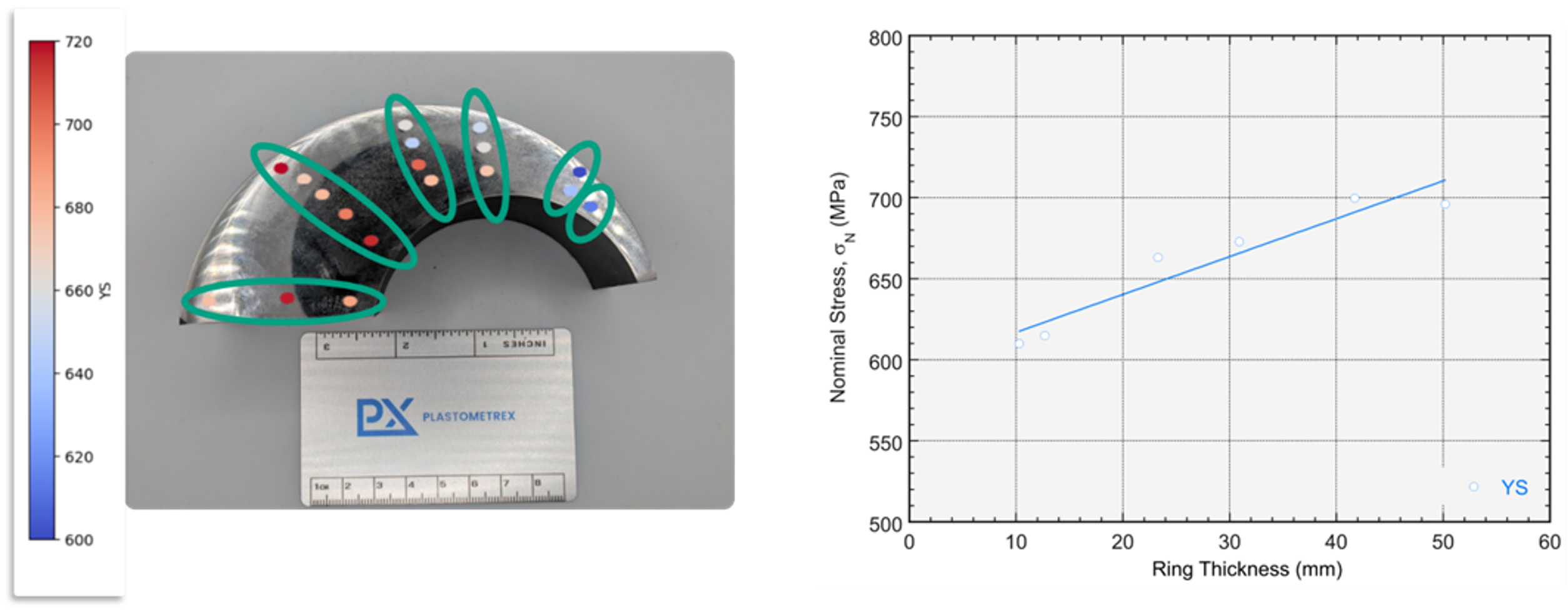
PIP testing was performed on a c-ring specimen manufactured from NASA HR-1 using LPBF with varying thickness around its arc (Figure 2). The fine spatial resolution of PIP allowed local yield stress to be mapped across the ring down to 3 mm intervals radially. When the local yield stress was mapped, it revealed a strong correlation between part thickness and local mechanical strength.
These results underscore a critical insight: small variations in AM processing or geometry can drive significant shifts in material behaviour. Even small changes in section thickness can produce localised shifts in yield behaviour that would be invisible to bulk testing.
Conventional testing methods, such as tensile testing, simply cannot provide this level of spatial resolution. Without this, qualification risks being based on incomplete or misleading mechanical data.
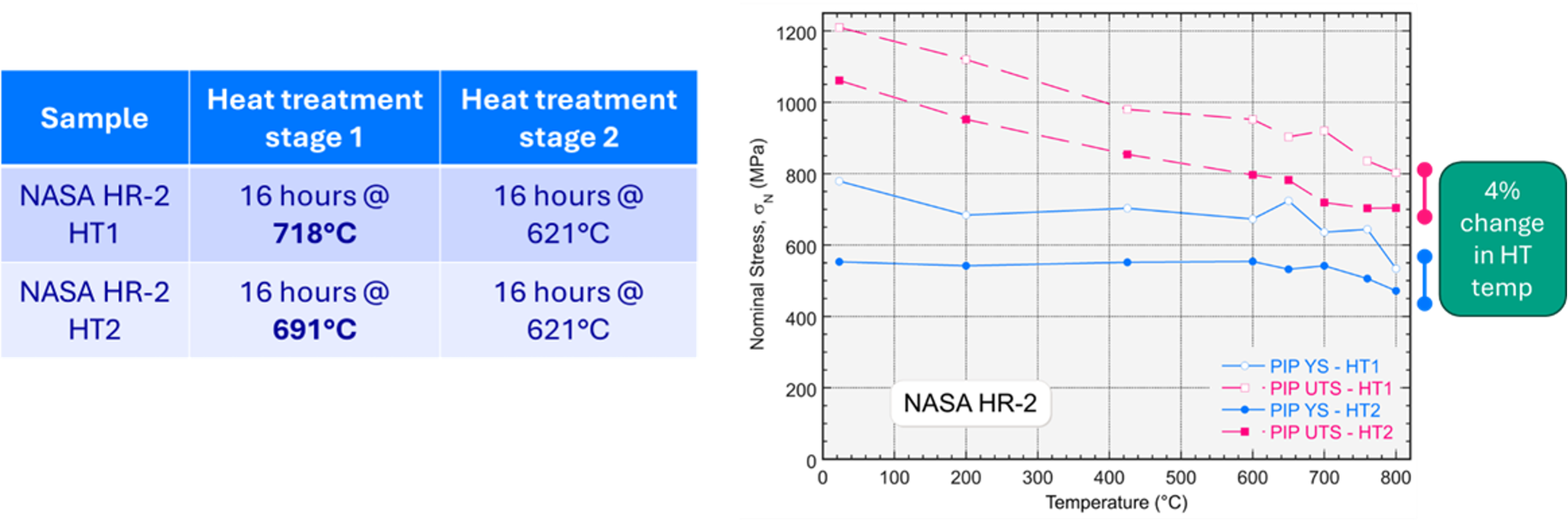
High temperature PIP testing was also carried out on NASA HR-2 samples. These components were produced via DED under two closely spaced heat-treatment conditions that differed by only 28°C during initial heating. High temperature mechanical behaviour was rapidly characterised up to 800°C using the PLX-HotStage. The results revealed a pronounced sensitivity to thermal processing: a small 4% change in heat treatment temperature resulted in a ~15% shift in mechanical properties across the tested temperature range (Figure 3).
Understanding components’ hyper-sensitivity to process conditions emphasises the importance of both accurate process monitoring and frequent quality assurance checks throughout manufacture.
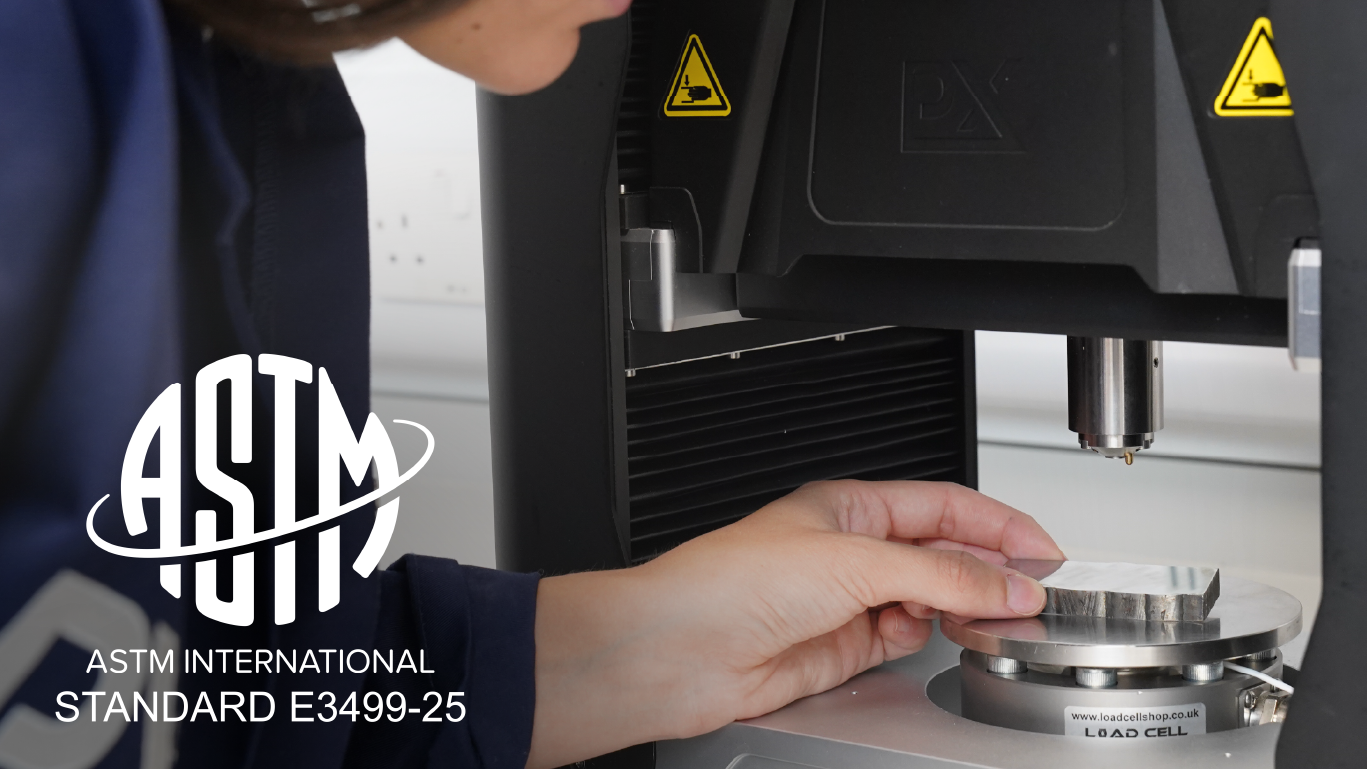
PIP testing provides a rapid, fine scale means of detecting these sensitivities early in the development cycle, without the time and cost burdens of traditional testing. Further, as an ASTM-standardised test method, the reliable, repeatable results provided by PIP testing can be utilised with confidence from qualification all the way through to production.
As organisations like NASA continue to push the limits of material performance, techniques such as PIP testing will play a central role in validating and optimising AM processes, ensuring that next-generation alloys like NASA HR-1 and NASA HR-2 meet the extreme demands of future missions.
This work was done in collaboration with Thomas Southern, Applications Engineer at Plastometrex, and Colton Katsarelis, Materials Engineer at the NASA Marshall Space Flight Center.
Interested in learning more? Click here.
Frequently Asked Questions
What are NASA HR-1 and HR-2?
They are iron-nickel alloys NASA developed for the extreme environment inside liquid rocket engines, where components must keep exceptional strength at high temperatures and withstand high-pressure hydrogen exposure. HR-1 was developed first, followed by HR-2. Both resist corrosion and hydrogen embrittlement while remaining easy to print, and both are compatible with DED and LPBF.
What did PIP testing reveal on the HR-1 c-ring?
PIP was performed on an LPBF c-ring with varying thickness around its arc. Its fine spatial resolution allowed local yield stress to be mapped across the ring down to 3 mm radial intervals, revealing a strong correlation between part thickness and local mechanical strength, the kind of variation that bulk testing would miss.
What did the high-temperature testing on HR-2 show?
HR-2 samples produced via DED under two heat-treatment conditions differing by only 28°C were characterised up to 800°C using the PLX-HotStage. The results showed pronounced sensitivity to thermal processing: a 4% change in heat treatment temperature produced a roughly 15% shift in mechanical properties across the tested temperature range.
Why can't conventional tensile testing capture this variation?
Tensile testing cannot provide the spatial resolution PIP offers. Small variations in AM processing or geometry, such as changes in section thickness, can drive localised shifts in yield behaviour that are invisible to bulk testing. Without that resolution, qualification risks being based on incomplete or misleading mechanical data.
Why does this matter for qualifying AM parts?
AM's design flexibility also makes parts sensitive: small changes in printing parameters, geometry, or heat treatment can significantly affect performance. PIP detects these sensitivities rapidly and at fine scale early in development, without the time and cost of traditional testing. As an ASTM-standardised method, its repeatable results can be trusted from qualification through to production.

Since completing his master's degree in Natural Sciences with a specialism in Materials Science and Metallurgy at the University of Cambridge, Marcus has worked closely with metallurgy and mechanical testing. He began working at Plastometrex in 2021 and has been closely involved in the research & development of the PIP methodology at both ambient and elevated temperature, working on the development of the PLX-HotStage high temperature module and supporting the publication of multiple peer review papers. Marcus' current role at Plastometrex is as an Applications Engineer, where he supports customer utilisation of the PIP methodology across the aerospace, defence and automotive industries.